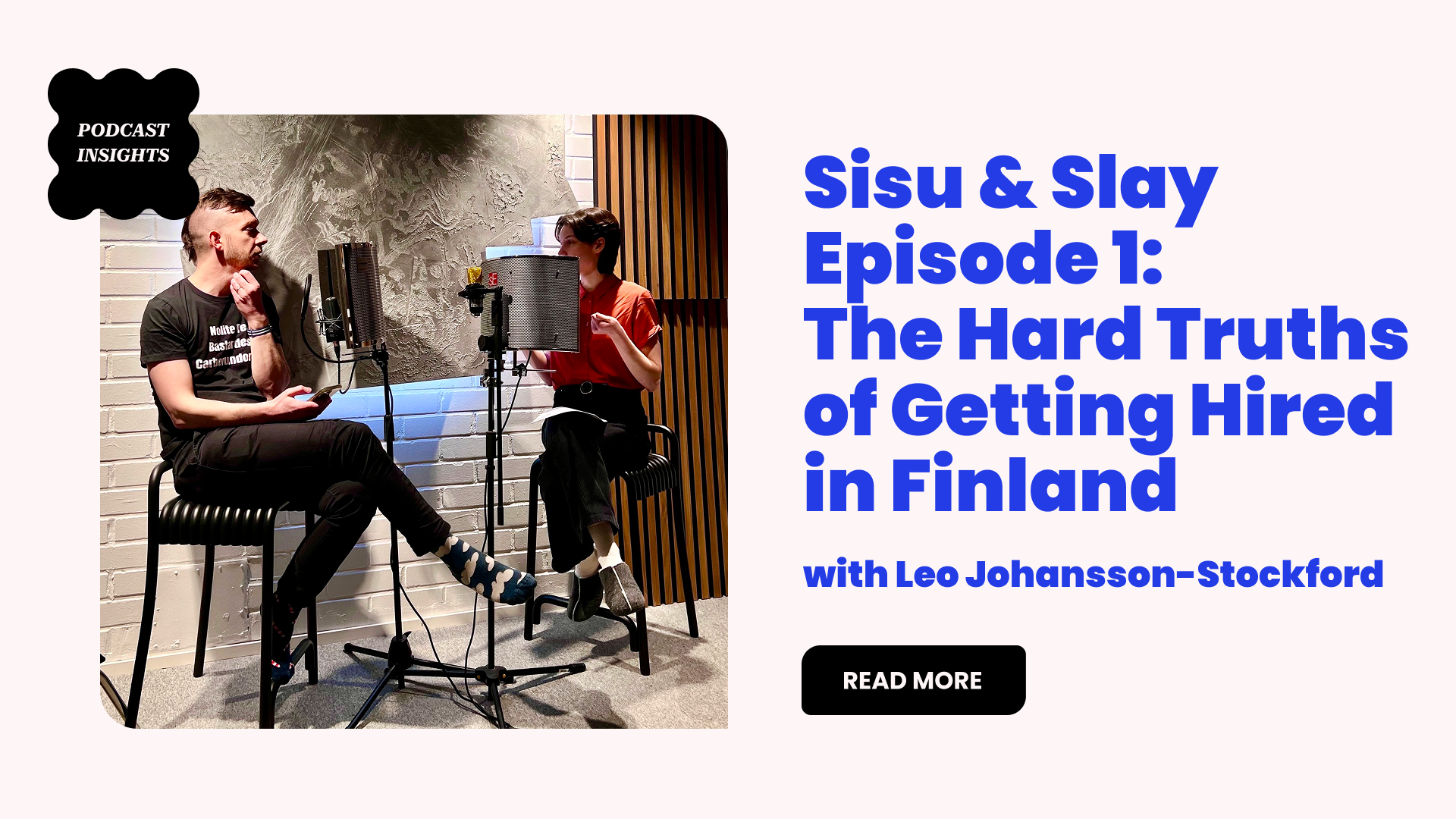
Sisu & Slay by Herizon: The Hard Truths of Getting Hired in Finland with Leo Johansson-Stockford
In the first episode of Sisu and Slay, host Viivi and guest Leo Johansson-Stockford sat down to do dive into the intricacies of recruitment processes, exploring evergreen truths, debunking myths, and discussing the role of AI in hiring. The importance of curiosity, networking, and tailoring applications still stand out as evergreen strategies in a competitive job market, particularly in Finland. The challenges faced by junior candidates were also discussed, and practical advice for aligning skills with recruiter expectations shared to help freshly graduated talent navigate their career search.
What Really Happens in Recruitment? Key Insights from Our Conversation with Leo Johansson-Stockford
Recruitment often feels like a black box. You send an application, wait, and then either hear back (or don’t) with very little visibility into what actually happened along the way.
In the first episode of Sisu & Slay by Herizon, we sat down with Leo Johansson-Stockford, Principal Talent Acquisition professional working with recruitment operations and AI, to unpack what really goes on behind recruitment processes in Finland, and why so much advice around job searching feels confusing or even contradictory.
Below are the key insights from our conversation.
1. Strong candidates aren’t perfect; they’re curious and self-aware
Across years of recruiting, Leo sees the same pattern repeat: candidates who move forward consistently are genuinely curious about the role and the company. They ask thoughtful questions, listen carefully, and reflect what they’ve learned back into the conversation.
Just as importantly, they understand both what they’re good at and what they’re not. Radical honesty builds trust. Hiring managers aren’t looking for people who can “do everything” — they’re looking for people who know themselves.
2. Networking works because it creates access and context
Networking is often framed as a vague must-do, especially in Finland. In reality, it has two very practical benefits.
First, it gives access to roles that are never publicly posted. Second, it puts candidates closer to the actual decision-makers. If a hiring manager has already met someone and wants them in the process, recruiters will support that.
However, networking only works when candidates are clear about what they want. Being specific about interests and direction makes it much easier for others to help.
3. AI isn’t automatically rejecting candidates. It’s still humans making decisions
One of the most common myths in recruitment today is that AI systems are automatically rejecting candidates without human involvement.
In reality, what often happens is:
- Recruiters use human-defined knockout questions (for example, work authorization)
- Applicant tracking systems may rank or group candidates
- Rejection emails may be delayed or AI-written, making them feel automated
The final decision to reject or proceed is still made by a human. The real risk lies not in AI itself, but in uncritical or lazy use of tools.
4. Using AI as a candidate is fine — accuracy is what matters
Leo doesn’t mind candidates using AI to help write or structure CVs and applications. What matters is that the information is accurate and that candidates can clearly explain what they’ve submitted.
AI can be a helpful tool for refining language and structure. It becomes a problem when it’s used to exaggerate experience or generate content the candidate doesn’t actually understand.
5. Impact matters more than buzzwords
Recruiters don’t just look at what candidates have done; they look at the results.
Statements without deeper context, like “managed a process” or “built a system”, are far less compelling than clear descriptions of impact: what changed, what improved, or what results were achieved.
This approach is especially powerful for career switchers or candidates with non-linear backgrounds. Translating past experience into outcomes that match the role makes a real difference.
6. For junior candidates, interest and initiative outweigh perfection
For early-career roles, hiring managers aren’t expecting immediate value. They’re looking for signals: curiosity, initiative, and evidence of learning.
Personal projects, school work, GitHub repositories, deep product understanding, or even treating the recruitment process itself like the job (particularly in sales) can set junior candidates apart.
Humility also matters. Claiming “expert” status too early often raises doubts rather than confidence.
7. Recruitment advice is scattered because fear spreads fast
A lot of recruitment myths persist because fear sells, and social media rewards engagement over accuracy. Many loud voices offering advice don’t actually work day-to-day with recruitment systems or hiring processes.
A useful filter is to ask:
- Where does this advice come from?
- Does this person actively work with recruitment?
- What’s their incentive for saying this?
Critical curiosity helps protect job seekers from unnecessary stress.
Final takeaway
If there’s one thing to remember, it’s this: tailor your applications to the role, even if it means applying to fewer jobs.
Humans still read CVs. Clear, role-specific applications matter. And when someone offers help, whether it’s feedback, review, or guidance, it’s worth taking it.
Recruitment is complex, but it doesn’t have to be mysterious.
You can listen to the full episode of Sisu & Slay by Herizon on selected platforms.