Sisu & Slay by Herizon: Is It Still Worth Becoming a Developer? with Duleepa "Dups" Wijayawardhana
What does it actually look like inside a modern software company? And with AI reshaping everything from how code gets written to who gets hired, is becoming a developer still a smart bet? We sat down with Duleepa "Dups" Wijayawardhana, Chief Impossible Officer at Supermetrics and Venture Partner at OpenOcean—to find out.
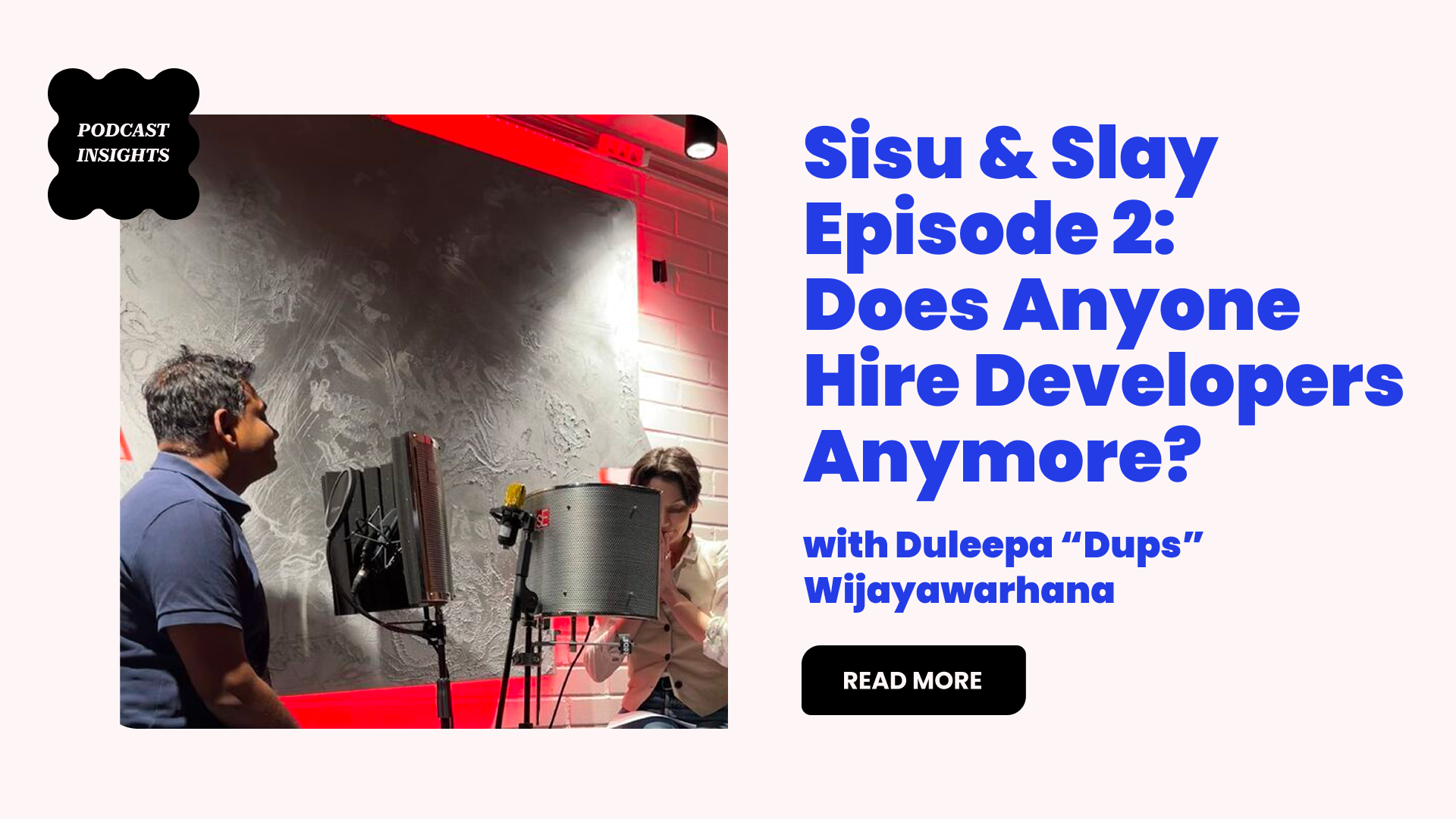
What does it actually look like inside a modern software company? And with AI reshaping everything from how code gets written to who gets hired, is becoming a developer still a smart bet? We sat down with Duleepa "Dups" Wijayawardhana, Chief Impossible Officer at Supermetrics and Venture Partner at OpenOcean, to find out.
Dups has been in tech since before the web existed. He's built teams, run a startup (and learned hard lessons doing it), and has spent the last few years stress-testing what happens when you try to build software using almost nothing but AI. He's also an immigrant four times over, which gives him a grounded perspective on what it means to navigate a new environment — professionally and otherwise.
Here's what we took away from the conversation.
How Engineering Teams Actually Work, and How That's Changing
If you've ever wondered what a "real" tech company looks like from the inside, Dups offers a simple frame: building software is like building a room in a house. Five people swinging hammers without a shared blueprint will produce chaos. Structure exists to prevent that.
The classic structure at a scaling SaaS company has been what Dups calls the product trio: a Product Manager who asks why and for whom, an Engineering Manager or Lead who figures out how, and a Designer who shapes the experience. This trio, plus a team of engineers, owns a problem space and ships solutions.
But that model is shifting. Fast.
The new dynamic? AI is enabling Product Managers to move from writing specs to building working prototypes; functional proofs-of-concept that can be put in front of real users within a day, not two months. The feedback loop collapses. And when that happens, the roles of the engineer and the designer have to evolve too.
"The meme was: you put four wheels on a car frame, then add the body, then refine it," Dups explained. "Now you're saying: here are all the pieces, build me a futuristic car — and then you hack off the bits that don't fit."
Does Anyone Still Hire Developers?
The short answer from Dups: yes. The longer answer is more interesting.
The developer of 2026 isn't the developer of 2021. But that's not new — the developer of 2001 wasn't the developer of 1991 either. Every wave of abstraction (from memory registers, to high-level languages, to the web, to the browser, to now) has caused the same anxiety. Each time, the fear is that the new layer makes the previous skills obsolete. Each time, it mostly just makes more people able to build things.
"Today I'm like a kid in a candy store," Dups said. "The world has opened up even further than it ever has."
What he sees as genuinely valuable now: generalist thinking, creativity, and the ability to work alongside AI tools fluently. Google, he noted, reportedly won't hire product managers today who can't "vibe code", in other words, use AI tools to prototype working software. That bar is only going to spread.
What Skills Are Rising — and What's Fading
On the up side: lateral thinking, curiosity, imagination, and what Dups calls being "well-rounded." He made the case for the humanities — understanding the why behind what people do is increasingly what separates someone who can prompt AI well from someone who just generates noise.
"We're coming to the age of the generalist," he said. "A diverse career path is a strength."
On the declining side: jobs where the value is pressing the same button reliably, every day. The pressure isn't just automation, it's self-automation. Companies increasingly expect employees to look at their own workflows and ask: " How do I make this faster? That's less a skill and more a mindset shift.
One strong note of caution, though: don't outsource your thinking to AI. "Don't let something else think for you," Dups said. Use it to teach you. Ask it what it changed and why. Everyone now has access to the world's best tutors for free; the question is whether you actually use that.
Advice for Junior Developers Right Now
Dups was honest that he's not the one facing the job market mountain; he's sitting comfortably on top of it, and he knows that. But his advice for junior developers was concrete:
Learn how the AI tools work. Not just how to use them, but how they think probabilistically, not deterministically. Understand why they sometimes go sideways. If you know that, you can catch the errors senior developers might miss precisely because they're set in old habits.
Learn design patterns and architectural concepts. Not to become a systems architect on day one, but so you can look at what the AI produces and recognize when something is going to break at scale. "You can ask it to interrogate itself, because you know enough to know what to ask."
Build things and put them out there. GitHub is your portfolio. Write about what you built. Show that you understand the problem, not just the code.
And beyond technical skills: be curious, visibly. Dups described the "Impossible Mission Force" team he helped build at Supermetrics. They hired for passion, for hobbies people actually cared about, for people who'd done different things and weren't afraid of AI tools. Curiosity, he said, is the one underrated trait that still separates the people who grow from the ones who get stuck.
The Bigger Picture
Perhaps the most quietly powerful moment in the conversation came when Dups reframed the whole question. We keep asking whether AI will replace developers. But zoom out, and the real story is that every wave of abstraction has expanded who can build things, not shrunk the field. There are more developers today than there were 30 years ago because the tools have become more accessible.
And now someone can build a niche app for their grandmother to manage her medication, software too specific to be commercially viable, but entirely buildable by one person with the right tools. That's new. That's meaningful.
The underlying systems still need to be built. The teams still need to work together. The creativity still needs to come from humans. The imagination, Dups said, is infinite, but diversity of thought is what makes it actually infinite.
"You might not think of the great thing. But five of us, from different backgrounds, together? We will."
Dups can be found on LinkedIn. He also hosts his own podcast, Tales Under the Cat Tree, at tales.dups.ca
Next episode of Sisu & Slay: Marie Juht, founder of Intra Integration, on taking active control of integrating into Finnish society.